

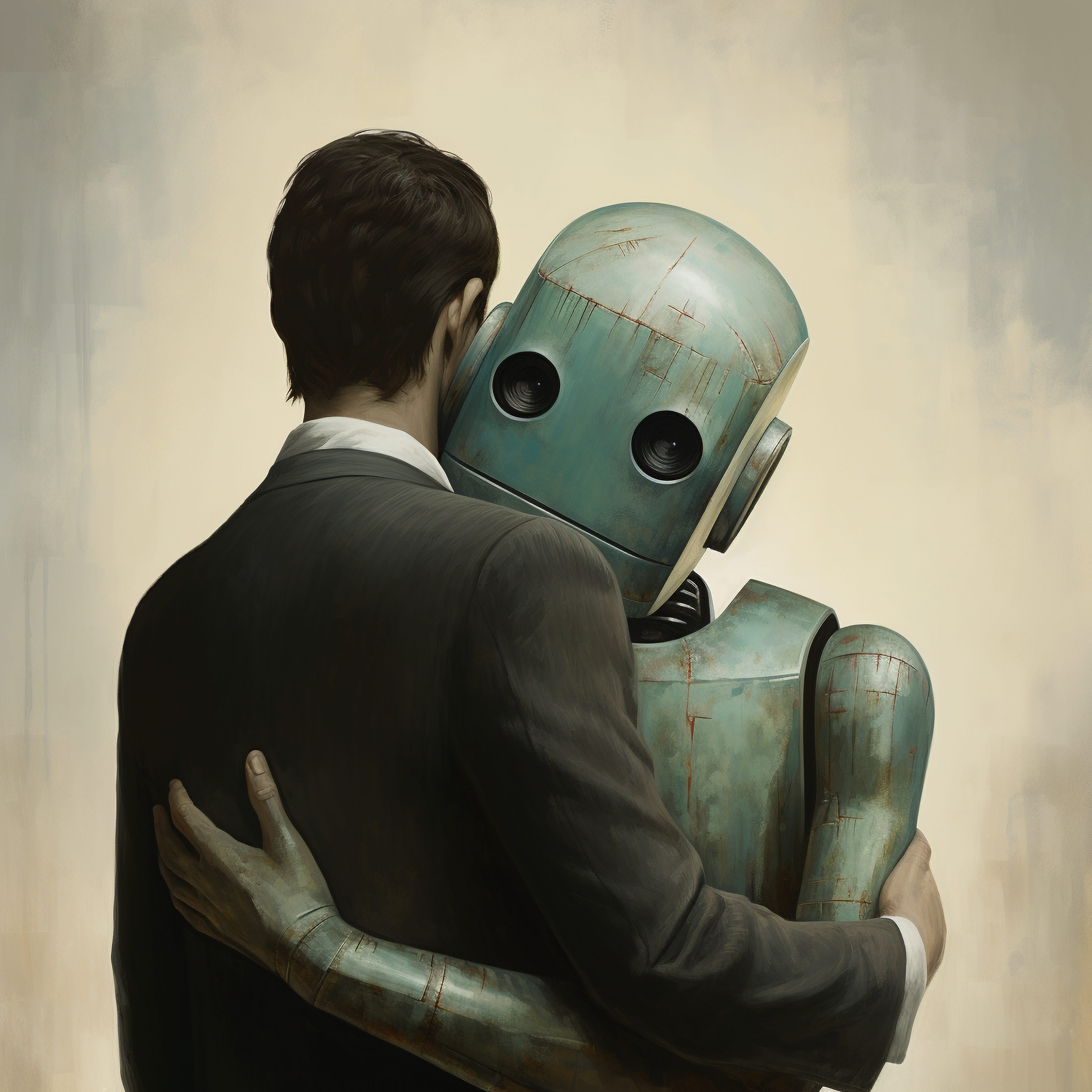
👉 As you read, I’d love to hear your thoughts: Are we building machines to reflect us, or to replace us? ⬇
AI isn’t getting closer to consciousness. It’s getting better at computation. And that difference isn’t just technical. It reshapes how we think about intelligence, design, and responsibility.
We’ve been telling ourselves a comforting story: that AI is slowly becoming more like us. That each leap in Machine Learning brings us closer to conscious machines: synthetic minds that think, reason, maybe even feel.
Why does this confusion keep coming back?
Because progress in AI doesn’t look like progress in tools, it looks like progress in behavior. When a system talks fluently, writes persuasively, or mirrors our tone, our brains do what they’ve always done: infer a mind behind the behavior. That instinct served us well with other humans. With machines, it quietly misleads us. In philosophical terms, we mistake behavioral similarity for ontological similarity. In cognitive terms, we overgeneralize a social inference mechanism evolved for other minds.
What if we’ve misunderstood the whole trajectory of AI? Not just a little wrong. Completely wrong. Not morally wrong. Mechanically wrong.
Despite the name, “neural networks” don’t think like brains. Not even close. And that matters. And confusing the two doesn’t just spark debate. It’s a practical risk with real-world implications for how we design, deploy, and depend on AI.
That doesn’t mean AI isn’t useful or “smart“ in its own way or that it lacks utility in domains that require "intelligent" output. But calling AI intelligence in the human sense risks conflating functional outcomes with conscious processes. Those two things may never converge.
Yes, both systems process information. But the mechanisms, constraints, and meaning attached to that information differ radically. A calculator and a poet both work with numbers and symbols but that doesn't make them equivalent. Here’s where the comparison breaks, in ways that actually matter.
This essay was sparked by an interview between Eduard Heindl and Joscha Bach (linked at the end). It pushed me to ask a harder question: what are we building when we build AI?
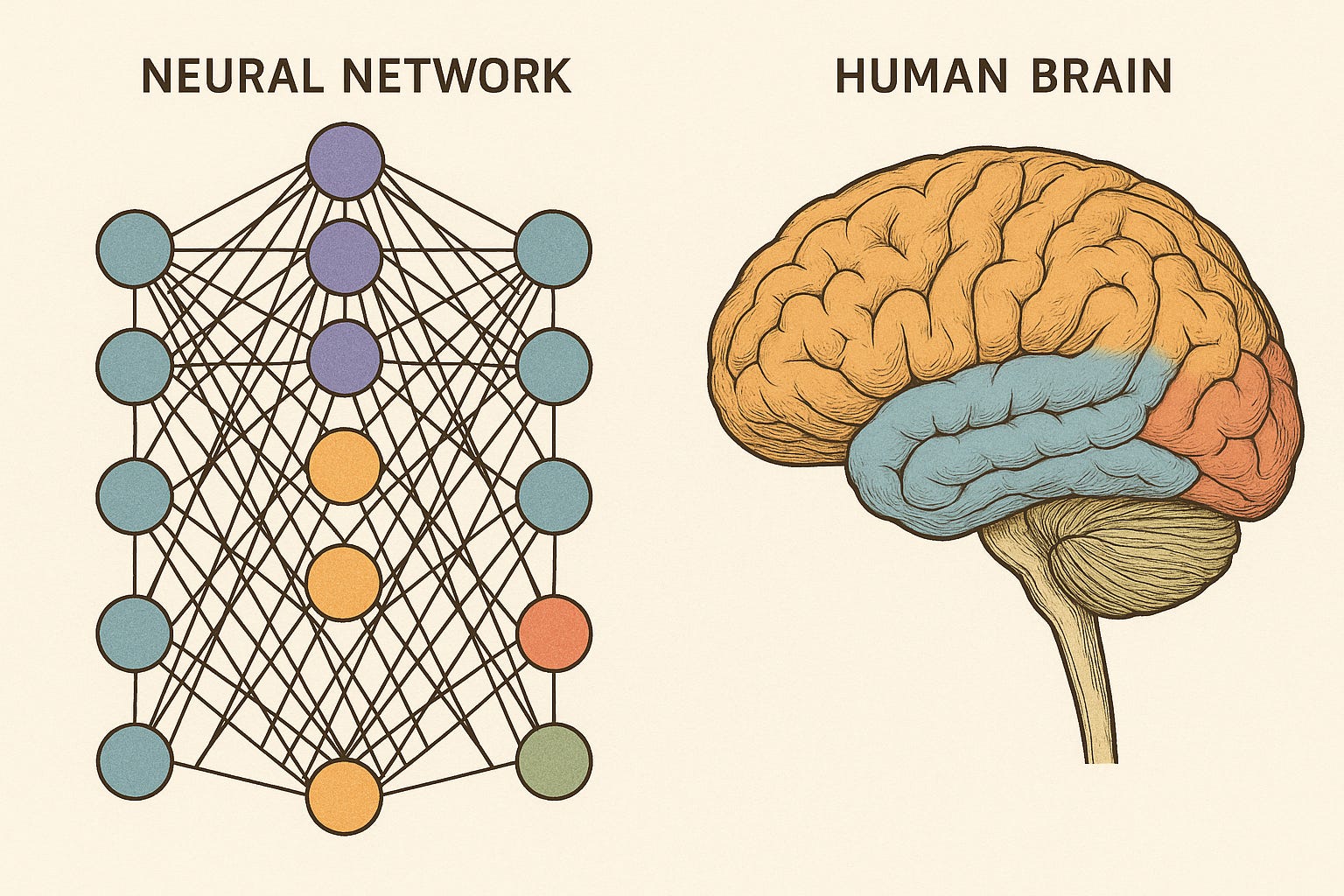
1. Structure: The Symphony vs. The Spreadsheet
Your brain is like a jazz band mid-improv.
AI follows strict instructions, more like a spreadsheet that runs the same formula over and over.
Artificial neural networks process inputs in highly ordered layers - one step after another, refining predictions with each pass. The math is elegant. The tradeoff is that the system only knows the world through the variables we give it.
Your brain? It’s a beautiful mess. It’s chaotic but beautifully adaptive. Billions of neurons firing in parallel, emotions crashing into memories, and visual input blending with smell, touch, and context, often all at once. You don’t just see a rose; you remember the one someone gave you on your birthday ten years ago, feel a rush of nostalgia, and then sneeze because of the pollen.
That difference changes everything. AI thrives in controlled environments with clear rules: chess boards, product recommendations, traffic light timing. But throw it into the ambiguity of real life sarcasm, grief, moral dilemmas, etc.) and it flounders.
That said, AI’s success in structured domains doesn’t make it useless elsewhere. It simply means we must tailor expectations to context, not project them from one domain to another.
Key takeaway: Machine logic isn’t the same as human thinking. Don’t mix the two. The architecture sets the limits. And architecture doesn’t just shape what a system can do. It shapes what it can notice and, therefore, what kind of explanation makes sense for it. A spreadsheet doesn’t fail because it’s slow or stupid. It fails because nothing inside it can care when the world changes.
2. Learning: Brute Force vs. Beautiful Inference
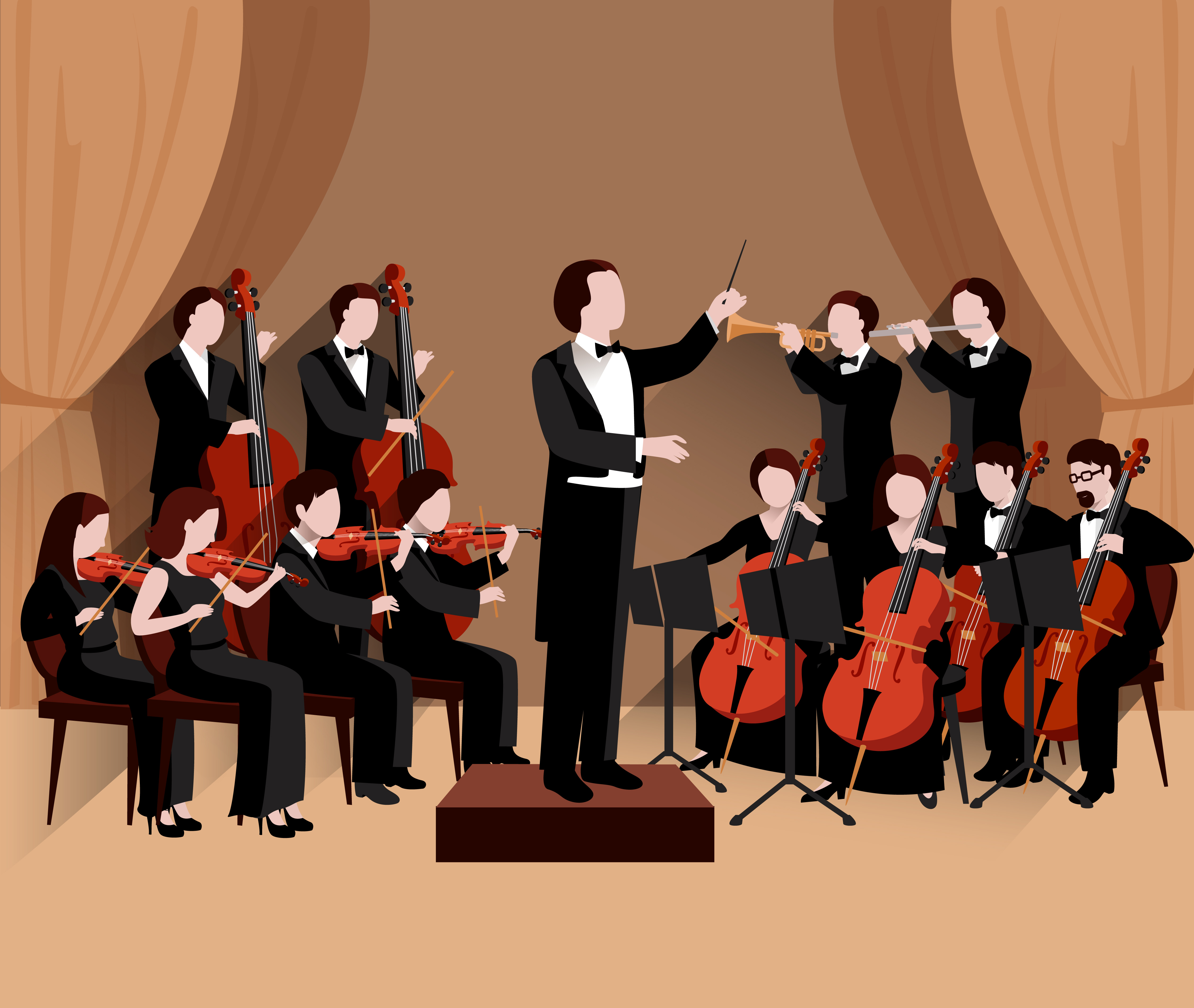
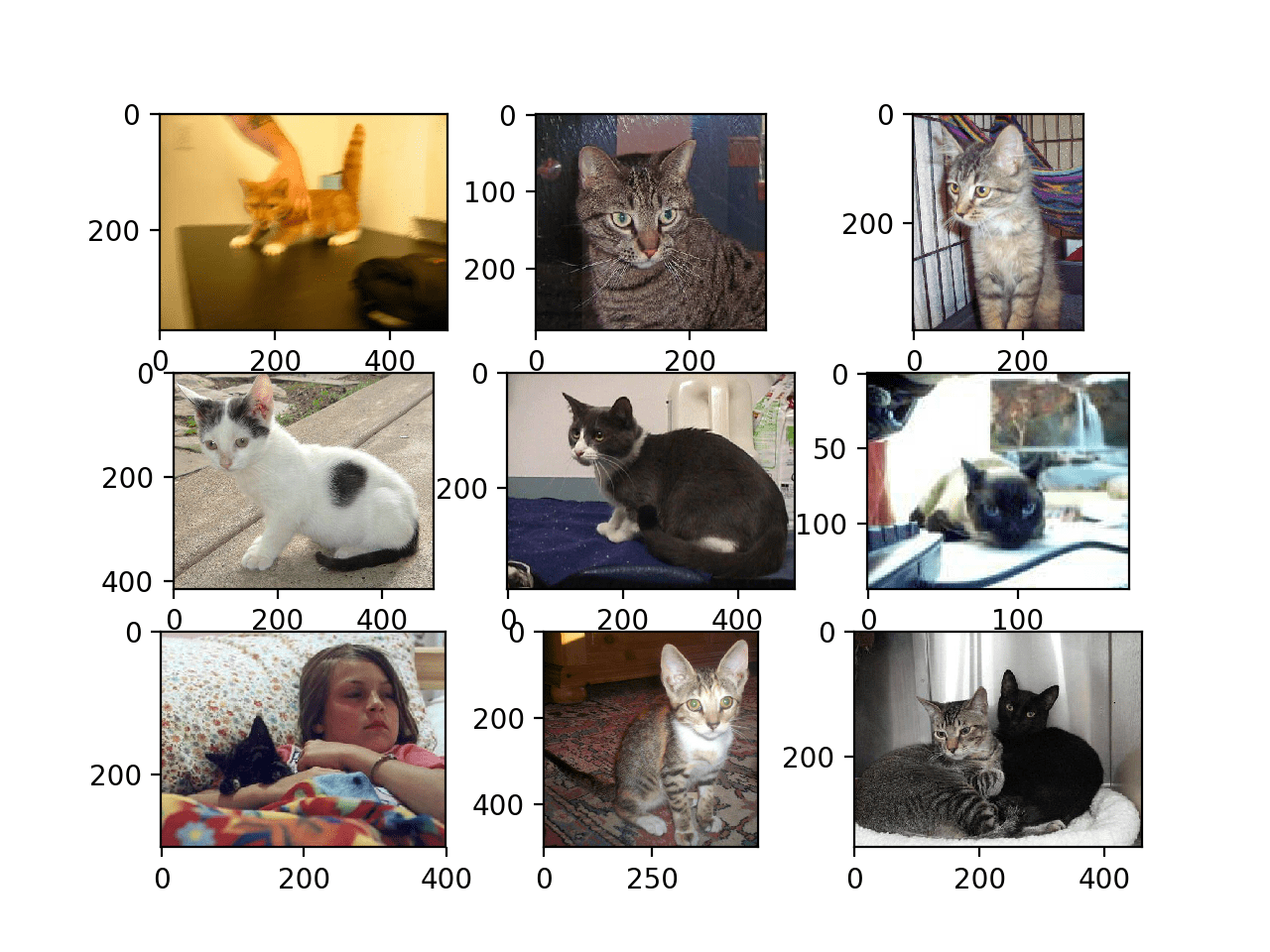
A toddler can recognize a cat after seeing just one or two.
AI has to study thousands, sometimes millions, of cat photos to figure it out.
Why? Because humans generalize. We don’t just memorize; we intuit. The brain says, “Ah, this furry four-legged thing seems to match what I saw earlier, even if it’s upside-down, cartoonish, or underwater”. Humans don’t start from a blank slate. We come preloaded with expectations about objects, agents, and causes - and those expectations do a lot of the learning for us.
AI, on the other hand, relies on massive exposure to statistical patterns. It’s impressive but also fragile. Feed it slightly skewed data or move it to a new context, and it breaks down.
There are exceptions. Some recent approaches, like few-shot learning and large language models with emergent properties, aim to mimic generalization. They’re still early-stage and they still rely on colossal pretraining datasets.
We’ve built machines that are really good at remembering but not so great at understanding. By understanding, I mean grasping context, drawing connections, seeing relevance, and adapting across situations - not just matching patterns. It’s the difference between solving a problem and knowing why the problem exists in the first place. One is performance. The other is understanding - and those two have never been the same thing.
One way to summarize the difference is this: humans build world-models, not just mappings. We don’t just associate inputs with outputs. We maintain a sense of how things persist, interact, and change when we’re not looking.
Most AI systems model correlations. Human cognition models a world we live inside.
I used to think this gap would shrink fast. Then I watched models ace a benchmark and stumble on a simple rewording of the same question. That’s when it clicked: we’re not watching a child grow up. We’re watching a different species of tool get sharper.
Key takeaway: Intelligence isn’t just about data. It’s about meaning. And that’s still a human superpower.
3. Memory: Frozen Snapshots vs. Living Stories
AI’s memory works like a filing cabinet. Once trained, it retrieves what it knows exactly as it was stored, until you retrain it. Static, fixed, and immutable.
The human brain? It’s more like a living novel, constantly rewritten. Every time you recall a memory, you reshape it. We remember through the lens of our present selves, colored by emotion and shaped by time.
This constant reconstruction is why we grow, why trauma heals (or festers), and why two siblings remember the same childhood differently.
It’s also why AI systems can’t adapt on the fly the way humans do. They don’t reframe. They reload.
Critics might note that reinforcement learning agents adapt based on feedback. Even here, their “adaptation“ is hard-coded and lacks the autobiographical continuity we associate with memory.
Of course, biological memory is far from perfect: bias, distortion, and false memories abound. But that imperfection is part of what makes it dynamic. Memory isn't just storage. It’s a system for evolving meaning across time and context.
This difference matters because responsibility depends on memory.
You can’t hold a system accountable if it can’t remember why it acted, only that it did.
Memory is what turns action into agency.
A log records what happened.
A memory explains why it mattered.
Not because human memory is accurate, but because it is answerable to a life over time.
Key takeaway: Flexibility isn’t a software upgrade - it’s a biological feature.
4. Decision-Making: Optimization vs. Lived Judgment
AI doesn’t “decide” so much as calculate. It runs probability engines based on past data and picks the highest-scoring outcome.
Humans? We leap. We feel. We trust our gut. We make split-second judgments that defy the data and still turn out right. Or at least, they turn out human.
When humans rely on intuition, they aren’t escaping data.
They’re drawing on a lifetime of embodied consequences that no dataset can replay.
Judgment is not just prediction under uncertainty.
It is acting under reasons, some of which only exist because a life can go better or worse. Reasons aren’t just inputs. They are things a system can be wrong about.
This doesn’t mean our choices are always better. But they’re richer. Our decisions reflect a complex soup of instinct, empathy, personal history, and yes, occasional irrationality.
This is why AI can crush us in poker but still doesn’t “get” a joke. Why it can write you a cover letter, but not comfort a grieving friend. AI lacks the substrate of lived experience - something no dataset can simulate.
Of course, some argue that human intuition is just unconscious pattern recognition. That may be true. But it's built from embodied experience, not just tokenized input-output sequences. There’s still no AI equivalent of “gut instinct” shaped by a lifetime of context.
Key takeaway: The future of decision-making should be augmented by AI, not surrendered to it.

5. Energy Use: Banana vs. Power Plant
Your brain runs on roughly 20 watts. That’s about the energy of a dim lightbulb, or a banana.
GPT-5 and other large models? They burn through megawatts and require entire server farms to function.
The human brain, through billions of years of evolutionary tinkering, became an energy miracle. AI remains largely brute-force in design. It’s powerful, but energy-intensive and context-fragile.
At scale, AI systems raise legitimate concerns around energy use, environmental impact, and access - particularly in regions with limited infrastructure. And yet, we talk about AI as if it’s the pinnacle of efficiency. Efficiency is not just a technical concern; it shapes who gets access to intelligence at all.
Cognition evolved under extreme energy constraints.
That constraint shaped what intelligence became.
To be fair, researchers across academia and industry are exploring approaches such as neuromorphic computing and edge AI, which aim to improve energy efficiency and adaptability. But we’re not there yet.
Key takeaway: Don’t mistake Artificial Intelligence for optimized intelligence. Nature still holds the energy crown.
Why AI Doesn’t Need to Be Like Us to Be Useful
AI is astonishing. It is among the most powerful tools humanity has developed. But it’s not a mind and assuming it is could lead to misguided assumptions and significant technical and ethical consequences.
Here’s what we should be thinking about:
Complement, don’t replicate.
We shouldn’t build AI to be like us. We should build it to do what we can’t or don’t want to. Let it handle the repetition. Let us handle the ambiguity.Redefine what “smart” means.
Smarter AI isn’t necessarily more human-like AI. True breakthroughs may come from building systems that think differently, not identically.Focus on adaptability.
The next real progress will come not from more data, but from systems that learn with fewer examples and more context. Meta-learning, transfer learning, contextual adaptation: these are the frontiers worth funding.Ask better questions.
Not “Can AI think like us?”.
But “What kind of intelligence are we building?”.
And “Who does it serve?”.
And let’s acknowledge: there’s room for debate. Some researchers believe Artificial General Intelligence (AGI) may eventually emerge - though even they often concede it may not look anything like human cognition. And they may be right. People argue endlessly about whether AGI is possible. The harder question is what kind of goals it would pursue, and whether those goals would align with ours.

Intelligence Is Not One Thing
We talk about intelligence like it’s a single finish line. But maybe it’s more like a landscape, with many peaks, many valleys, and many paths.
Human cognition is one path. AI is another. And trying to make one think like the other is like asking a violin to play percussion: it’s the wrong instrument for the job.
Instead of trying to recreate ourselves in silicon, maybe the better path is to understand what makes us unique and protect it.
Because in the end, the question isn’t whether machines will become like us. It’s whether, in our pursuit of building them, we lose sight of what made us human in the first place and why it still matters.
We also need to ask: Who benefits from this metaphor of machine-as-mind? And who might be harmed if we get it wrong? Misunderstanding AI isn’t just a technical error, it shapes everything from policy to access to how we teach the next generation about intelligence itself.
It’s also worth asking why the machine-as-mind metaphor persists.
Consciousness sells. Mystery attracts funding.
Saying “this system predicts” is accurate but saying “this system understands” is persuasive. Metaphors don’t just shape thinking. They shape incentives.
Understanding the difference between computation and cognition isn’t academic. It’s how we keep our future humane.
Every generation builds tools that mirror its self-image. The risk isn’t in machines becoming more human. It’s in us quietly shrinking the meaning of “human” to match what machines can do.
The deepest risk isn’t Artificial Intelligence. It’s conceptual laziness about what intelligence is.
Practical Takeaways
Don’t treat AI like a person. Respect it for what it is and be cautious of what it isn’t.
Invest in building complementary systems, not clones of ourselves.
Prioritize education and policy that acknowledges the limits of AI and centers human judgment.
Pay attention to energy use. Scaling AI without considering sustainability is a dangerous blind spot.
Most importantly: stay curious, stay reflective, and keep asking who benefits from the intelligence we’re shaping.
Sources & Links
👉 Agree, disagree, or land somewhere in between? Drop a comment and join the conversation - I’d genuinely love to hear your perspective. ⬇
If this resonated with you, consider subscribing to receive more insights like these straight to your inbox. Together, we can continue the conversation and shape the future on our own terms.
The views expressed here are entirely my own. This newsletter is not affiliated with any organization, and no confidential or non-public information is shared.
Wow, this is so sharp! Can you elaborate on ontological versus behavioral similairty?